
The Easter Table, Refined: Brioche, Millefeuille & the Architecture of French Pâtisserie
Easter, across Europe, has long signaled a return to richness—both in ingredient and in experience. Following the restraint of Lent, when butter, eggs, and sugar were traditionally limited, the Easter table becomes an expression of abundance. It is here that brioche takes its place—not merely as bread, but as a celebration of craft. Classified as a viennoiserie, brioche is defined by its high proportion of butter and eggs, creating a tender, aerated crumb and a deep golden crust. This composition is not incidental; it reflects centuries of refinement within French baking, where enrichment was reserved for moments of significance.
Historically, brioche evolved from regional enriched loaves into a staple of French culinary identity, finding its place in both domestic and professional kitchens. Its role at the table is foundational. Whether presented as a braided centerpiece or portioned into refined individual formats, brioche offers both structure and warmth—an anchor that supports the progression of a meal. Its subtle sweetness and delicate crumb allow it to transition seamlessly across service, from composed savory dishes to indulgent brunch applications such as pain perdu.
The Discipline of Layers: Millefeuille
If brioche represents generosity, millefeuille represents discipline.
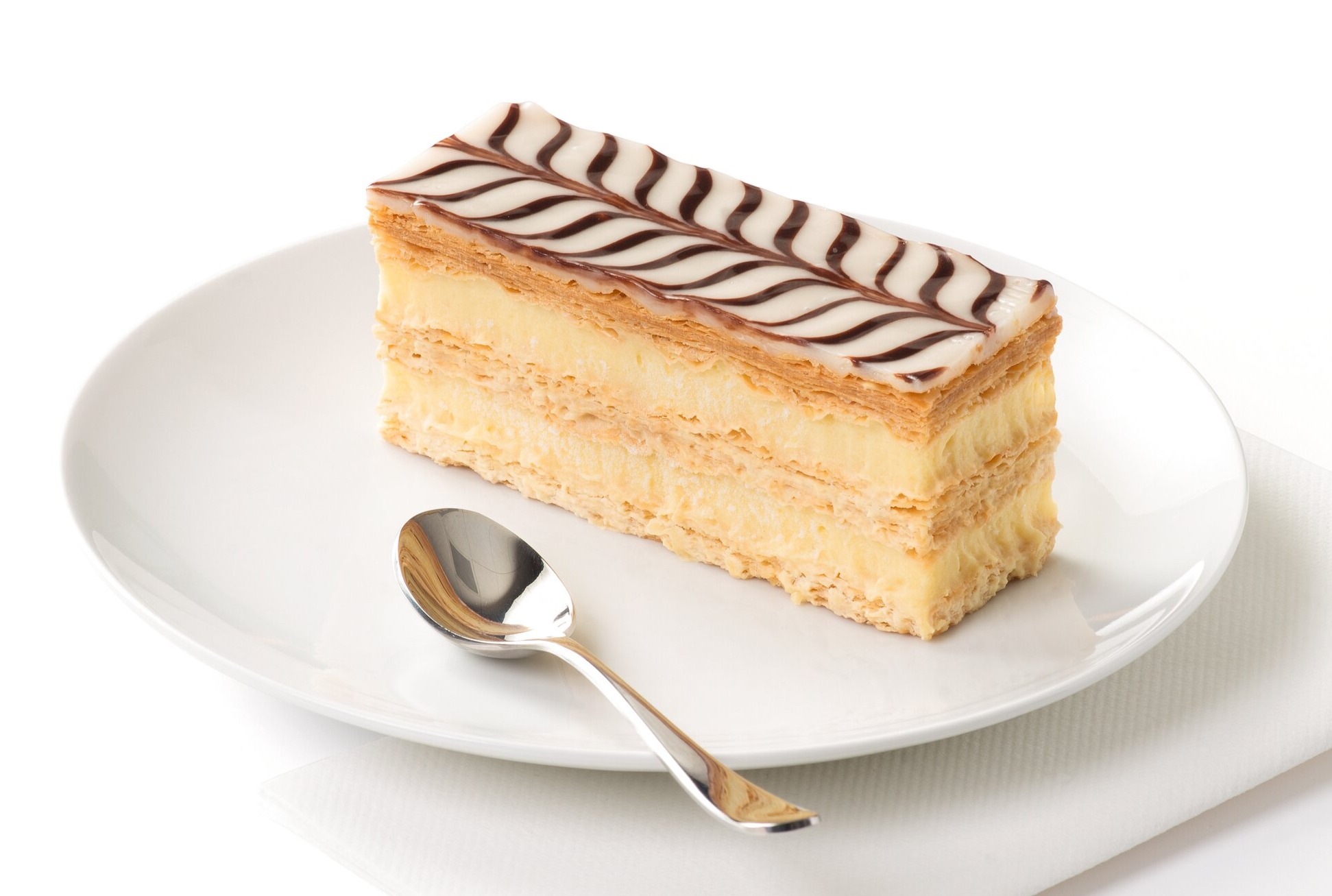
First documented in 17th-century French cuisine, with early references appearing in François Pierre de La Varenne’s Le Cuisinier François (1651), millefeuille reflects the emergence of technical precision in European pastry. Its name—“a thousand leaves”—refers to the laminated structure of puff pastry, where successive folds of butter and dough create hundreds of delicate layers. When baked, these layers rise through steam, producing a pastry that is at once crisp, airy, and structurally defined.
By the 19th century, the dessert was further refined by Marie-Antoine Carême, whose work laid the foundation for haute cuisine. The addition of pastry cream between layers and the standardization of its form elevated millefeuille into a benchmark of professional pâtisserie. Today, its relevance endures not as tradition alone, but as a demonstration of balance—between texture and softness, structure and delicacy.
Opéra: Precision, Balance, and Modern Pâtisserie
Where millefeuille speaks to classical technique, the Opéra cake reflects the evolution of pâtisserie into modern refinement.
Developed in Paris in the 20th century and widely attributed to the house of Dalloyau, the Opéra is composed with architectural intent. Thin layers of almond sponge (Joconde), coffee syrup, chocolate ganache, and coffee buttercream are assembled with precision, then finished with a smooth chocolate glaze. Each layer is calibrated so that no single element dominates; instead, the experience is one of cohesion—coffee, chocolate, and almond in perfect proportion.
Its design is deliberate. The cake is cut into precise rectangles, ensuring that every bite delivers the same balance of flavor and texture. In this way, Opéra represents a shift in pastry philosophy—from decorative indulgence to structured, repeatable excellence.
A Complete Composition of the Table
What unites brioche, millefeuille, and Opéra is not only their origin, but their role within the rhythm of a meal.
Brioche establishes the foundation—rich, inviting, and versatile
Millefeuille introduces contrast—light, crisp, and texturally dynamic
Opéra concludes with precision—layered, balanced, and refined
Together, they form a complete composition. Not simply individual products, but a progression—guiding the guest experience from first impression to final course.
For chefs, these elements offer more than familiarity. They provide reliability, structure, and a language of quality that is immediately understood. In high-level hospitality environments—where expectation is defined by consistency as much as creativity—these classics remain indispensable.
Easter, Elevated
In today’s kitchens, where time, labor, and precision must align, the value of these products lies not only in their heritage, but in their performance. They deliver consistency without compromising integrity. They allow chefs to execute at a high level while maintaining efficiency across service.
This is the essence of the modern Easter table:
not excess, but intention.
not tradition alone, but refinement.
At Landert Bread, we curate these European classics with a focus on authenticity, quality, and versatility—ensuring that each product arrives ready to perform in professional kitchens.
Because in the end, Easter is not simply served.
It is composed.
Search Blog
Categories
Archives
- June 2026
- May 2026
- March 2026
- March 2025
- September 2024
- August 2024
- July 2024
- June 2024
- February 2022
- June 2021
- April 2021
- January 2021
- June 2020
- May 2020
- April 2020
- March 2020
- February 2020
- January 2020
- December 2019
- October 2019
- August 2019
- March 2017
- February 2017
- January 2017
- December 2016
- November 2016
- October 2016
- September 2016
- August 2016
- July 2016
- June 2016
- May 2016
- April 2016
- March 2016
- February 2016
- January 2016
- December 2015
- November 2015
- October 2015
- September 2015
- July 2015
- June 2015
- April 2015
- January 2015
- December 2014
- October 2014
- August 2014
- July 2014
- May 2014
- January 2014
Recent Posts
- Small Rolls, Big Impressions: A Tour Through Europe’s Favorite Dinner Rolls
- Why Rye Has Been Europe’s Best-Kept Health Secret for Over 2,000 Years.
- Summer Starts Here
- The Standard Behind the Bread: Why Ours Is Never Bromated
- The Easter Table, Refined: Brioche, Millefeuille & the Architecture of French Pâtisserie